
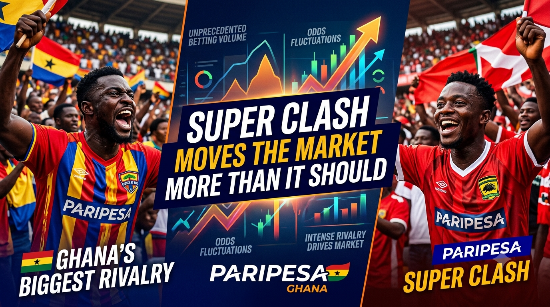
Paripesa Ghana, why the Super Clash moves the market more than it should
Kotoko against Hearts of Oak is the one fixture that stops conversations across the whole country, not just in Kumasi or Accra. Ghanaians call it the Super Clash for good reason, and it draws more betting volume than any other domestic match by a wide margin. None of that volume makes the price on it more honest. If anything, it tends to work the other way.
Anyone browsing Paripesa Ghana during Super Clash week will notice the market moves fast and stays active right up to kickoff. That level of activity is exactly why pricing on the derby behaves differently from a quiet midweek fixture between two clubs chasing a top four finish rather than a trophy.
Contents
Heavy betting does not automatically mean accurate pricing
A market with a lot of money moving through it corrects quickly, that part is true. What it corrects toward is a separate question. When Kotoko’s twenty four titles and Hearts of Oak’s twenty one collide, money floods in based on history and loyalty as much as on the actual squads taking the pitch that day, and pricing shifts to manage that lopsided demand rather than to reflect a clean read of current form.
This pattern shows up in football betting everywhere, not just in Ghana. On Paripesa or any other sportsbook, the bigger and more emotionally loaded a fixture becomes, the more its price reflects where public sentiment is flowing rather than a sober read of two teams on paper.
Where the Premier League actually holds more value
A midweek fixture between Bechem United and Berekum Chelsea gets a fraction of the coverage that a Super Clash receives, and a fraction of the betting money too. Fewer people scrutinising a price means fewer chances for that price to be corrected before kickoff, and while that cuts both ways, it tends to leave more room for a patient reader to find value that heavy public money has already erased in the derby.
Clubs like Medeama and Aduana Stars have shown they can compete at the top of the table without carrying anywhere near the emotional weight of the two Kumasi and Accra giants, and their matches against mid-table sides receive nowhere near the same scrutiny a Super Clash gets, even when the result matters just as much for the title race.
Three reasons the gap exists
Reach is the first factor. A club rivalry, however historic, still draws its intensity from two specific fanbases. A Super Clash erases that limit entirely, pulling in interest from people who could not name a Bechem United starting eleven but know exactly when Kotoko plays Hearts of Oak next. Emotional weight is the second factor, built over decades of shared history that outlasts any single season’s form. Media coverage is the third, since a Super Clash dominates radio phone-ins and back pages for days, while a midtable fixture gets a single preview article if it gets anything at all.
Comparing the two types of fixture
|
Factor |
Super Clash |
Midtable Premier League fixture |
|
Betting volume |
Very high |
Low to moderate |
|
Media coverage before kickoff |
Extensive, days of build-up |
Minimal, often a single preview |
|
Speed of price correction |
Fast, but toward public sentiment |
Slow, toward the original model |
|
Emotional betting influence |
Significant |
Limited |
|
Typical pricing gap |
Narrow but potentially skewed |
Wider and less examined |
What actually moves a quieter result
Coaching changes matter more here than fans often assume. Kotoko’s own managerial upheaval this season is a reminder that squad instability can shift a team’s level within weeks, and the market does not always catch up quickly when a new interim coach takes charge for an unfamiliar fixture. Injuries to key players carry more weight in a squad with a shallower bench, which describes most Premier League sides outside the two or three best resourced clubs. Home advantage is the third factor worth tracking, and it varies more between grounds than the league table alone would suggest.
A short checklist helps before betting on a quieter fixture:
The derby is still worth watching, just not for the reasons bettors assume
None of this argues against enjoying the Super Clash, which remains the biggest event in Ghanaian football regardless of what the betting market does with it. It argues for treating its price with more scepticism than a quieter fixture receives, precisely because so much national sentiment pushes in the same direction at once.
Conclusion
A busy market is not automatically an accurate one, and a quiet market is not automatically broken. The Super Clash pulls in the volume and the headlines, but that same volume can push the price toward what fans want to believe rather than what current form actually supports. Whichever platform someone uses, Paripesa included, the Premier League’s quieter fixtures get far less scrutiny, and that gap in attention is exactly where a patient, detail focused approach tends to find more value over time.
None of this changes the basic responsibility that comes with any bet. Set a budget before the match starts, treat it as the cost of entertainment rather than a plan to make money, and if betting starts to feel less like a hobby and more like a habit that is hard to stop, reaching out to a professional or a support service is always the right call.
FAQ
Why does a heavily bet match not always have an accurate price?
An accurate price closely reflects the true probability of each outcome, and heavy betting volume only corrects a price toward what the betting public collectively believes, not necessarily toward the truth. When that belief is shaped by loyalty and history rather than current form, high volume can reinforce a skewed price instead of fixing it.
Are midtable Premier League matches riskier to bet on than the Super Clash?
Risk here refers to the uncertainty around whether the posted price matches the real probability of the result, and midtable fixtures carry more of that uncertainty simply because fewer people and less analysis shape the price. That uncertainty can work in either direction, offering more potential value as well as more potential for the price to be wrong.
Does a coaching change really affect the odds on a football match?
A coaching change means a new manager takes charge of tactics, team selection, and preparation, often with limited time to implement any of it before the next fixture. This tends to matter more in less scrutinised matches, where fewer analysts are actively tracking how a squad performs under new management before the odds are finalised.
Join Our WhatsApp Channel To Receive Updates
Join Our Facebook Channel To Receive Updates
Click Here to Join Our Telegram Channel To Receive Updates